5 Things You Should Know About How to Cheat in Chess.com
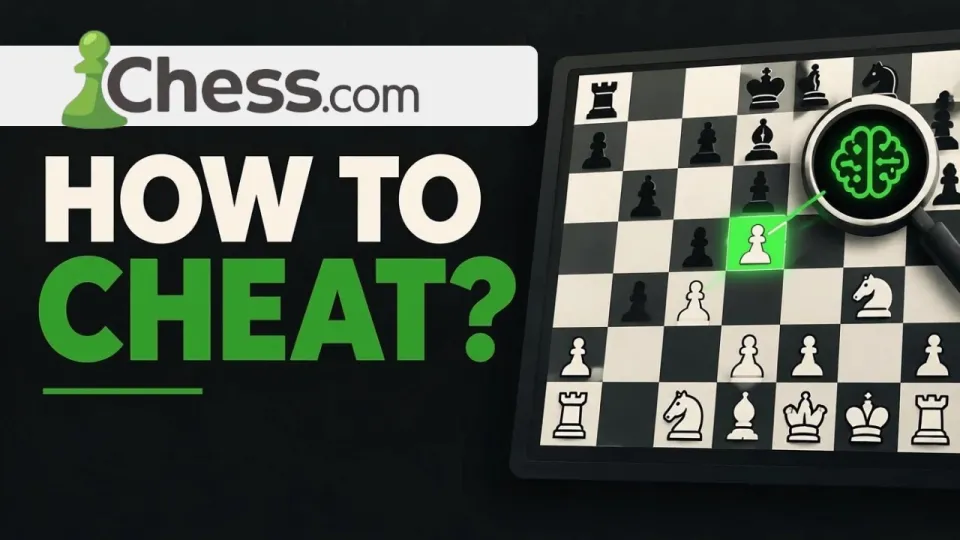
Video: How to cheat in Chess.com (Chess.com cheats)
· based on the channel Matyc
Key takeaways
- Chess.com's anti-cheat compares your moves against engine top choices across many games, not just one.
- Browser userscripts and extensions that overlay engine moves are the most common method shown in tutorials.
- Account closure is the standard penalty, and Chess.com also voids prize events and can report to fair-play bodies.
- Engine cheating is easiest to detect in long games with high accuracy and low time usage per move.
- Paid cheat tools and 'undetectable' claims are unverifiable; many are malware or repackaged free scripts.
Cheating on Chess.com usually means running a chess engine such as Stockfish in parallel with your game and copying its suggested moves, most often through a browser userscript or extension that overlays engine output on the board. Tutorials like the one from Matyc point viewers to a browser-based cheat tool hosted on xmods.cc that claims to add engine assistance to live games. The method is technically real, but so is the detection: Chess.com's fair-play team closes accounts for engine use regularly, and the risk grows with every game you play.
How engine-assisted cheating in Chess.com actually works
The core of any chess.com cheat is a chess engine. Stockfish is free, open source, and far stronger than any human player, so the only technical problem is getting its moves into your game without switching windows. That is what the tools sold and shared in tutorials do:
- A userscript manager such as Tampermonkey (or a browser extension) is installed in Chrome, Firefox or Edge.
- A script from a site like xmods.cc is added to the manager and activated on chess.com pages.
- The script reads the position from the page and sends it to an engine, either locally or through a remote API.
- Suggested moves appear as an overlay or arrow on the board, and the player makes those moves manually.
Some variants run the engine in a separate window and require manual position entry; others automate the whole loop. The overlay approach is the one most tutorials demonstrate because it needs no second device and works in the browser on both Live and Daily games.
Why Chess.com's anti-cheat catches most cheaters
Chess.com does not rely on a single suspicious game; it builds a statistical profile of every account. The fair-play system looks at move-by-move agreement with engine top choices, accuracy scores, time spent per move, and consistency across hundreds of games. A player who suddenly jumps from 45% engine match to 85% is flagged, and so is anyone whose accuracy stays near engine level in long games while making instant moves in complex positions.
Detection is strongest in these situations:
- Long time controls, where a human has time to think and an engine user's near-perfect accuracy stands out.
- High move-agreement rates sustained over dozens of games, not one lucky session.
- Unnatural timing patterns, such as identical thinking times in trivial and critical positions.
- Reports from opponents, which trigger a manual review even when statistics alone are borderline.
The standard penalty is account closure, and Chess.com also strips ratings, voids results in prize events, and can share findings with other platforms and fair-play bodies. Bans are applied retroactively, so a cheat that seems to work for weeks can still end in a closed account.
Typical questions from players trying chess.com cheats
Most confusion around these tools is practical rather than ethical. The recurring questions are about activation, visibility and reliability.
- How do I use it during a game? The script has to be enabled before the game starts and the chess.com tab reloaded; if the overlay does not appear, the userscript manager usually has the script disabled or the wrong URL match pattern.
- Why can't I find the tool? Cheat repositories get taken down or moved frequently, and links in old videos often go dead; that is why tutorials push viewers to a single landing page instead of a direct file.
- Does it work on mobile? Browser extensions and userscripts are a desktop feature; the Chess.com app cannot run them, so mobile users have no equivalent method.
- Is it really undetectable? No tool can honestly promise that. Chess.com's detection works on statistical patterns after the fact, so nothing running in your browser can guarantee an account survives review.
A separate practical concern is safety: userscripts run with full access to the pages you visit, and repackaged "premium" cheat builds have a long history of carrying adware or credential-stealing code.
What cheating costs you beyond the ban
A closed account is the visible cost, but the damage goes further. Ratings, game history and years of legitimate improvement disappear with the account, and Chess.com ties fair-play enforcement to payment details and device fingerprints, which makes returning harder than creating a new email. In serious events, organizers can impose separate suspensions that follow a player to over-the-board tournaments.
There is also the learning side: engine assistance removes the feedback loop that makes a player improve. A 1200-rated player who copies Stockfish moves for a month does not become a 2000-rated player; they become a 1200-rated player with a hidden engine and no new understanding of openings, tactics or endgames. Puzzle ratings, analysis habits and pattern recognition all stall.
Safer alternatives that raise your rating legitimately
If the goal behind searching for chess.com cheats is a higher rating, the same tools that power cheating can be used legally. Stockfish and Chess.com's own analysis board are allowed for post-game review, and opening explorers such as the Chess.com explorer show what strong players choose in your lines.
A workable routine looks like this:
- Play slower time controls (10+0 or 15+10) so you actually calculate.
- Review every loss with the engine and write down the first move where the evaluation swung.
- Drill the tactical patterns you missed in Puzzle Rush or the puzzle trainer.
- Build a small opening repertoire of two or three lines per color and check it against the explorer.
This produces measurable rating gains within a few months, and none of it puts the account at risk.
Links from the video
- xmods.cc cheat tool page — the site linked in the tutorial as the source of the chess.com cheat script.
Final takeaway on chess.com cheats
Engine-assisted cheating on Chess.com is technically simple — a userscript plus Stockfish — but it is statistically visible, and the platform's fair-play team closes accounts based on patterns across many games rather than single matches. The tools promoted in tutorials carry real risks: dead links, malware, and a ban that erases ratings and history. The channel Matyc walks through one such method in the video above, but the practical outcome for most users is a closed account rather than a higher rating. If you want to test the tool described, the xmods.cc item page is where the tutorial sends viewers, and it is worth reading the risks before installing anything.
Questions & answers
How do I actually use a chess.com cheat during a live game?
The script has to be installed in a userscript manager such as Tampermonkey and enabled before the game begins, then the chess.com tab is reloaded so the overlay loads. If nothing appears on the board, the script is usually disabled or its URL match pattern does not cover the game page. The moves still have to be played manually.
Can Chess.com detect engine cheating?
Yes. Chess.com's fair-play system compares your moves with engine top choices across many games, tracks accuracy and time per move, and flags sudden jumps in move agreement. Detection often happens after the fact, so an account can be closed weeks after the games were played.
Does a chess.com cheat extension work on the mobile app?
No. Userscripts and browser extensions only run in desktop browsers such as Chrome, Firefox or Edge. The Chess.com mobile app cannot load them, so there is no equivalent method on phones or tablets.
Is it safe to install cheat scripts from sites like xmods.cc?
There is no way to verify safety from the outside. Userscripts run with broad access to the pages you visit, and repackaged cheat builds have a history of carrying adware or credential-stealing code. Any claim of being undetectable should be treated as marketing rather than a guarantee.
Source: How to cheat in Chess.com (Chess.com cheats) · Markdown version